The right invoice number format gives every bill a unique identity that is easy to find, report and match to a payment. For Indian businesses issuing GST tax invoices, a good system follows Rule 46, stays within 16 characters and continues in a clear series through the financial year.
What you need before choosing a number
Decide these four things before creating the next invoice:
- Whether you need a tax invoice, bill of supply, receipt or another document series.
- Whether you need separate series for branches, counters, online sales or document types.
- The financial year you are numbering, such as
2026-27. - A single place where the next number is recorded, so two people do not issue the same number.
If you are registered under GST, keep the complete invoice number within the GST rule. If you are not registered, the same disciplined approach still makes your receipts easier to search and reconcile, but do not label a document as a GST tax invoice unless it is appropriate for your business.
Step 1: Why invoice numbers matter
An invoice number is the short reference that connects the PDF, your accounting record, the customer conversation and the payment entry. A customer can quote INV/26-27/0042 in an email, and you can find the exact invoice without searching by name, date and amount together.
Numbering also makes gaps visible. If your list goes from INV/26-27/0041 to INV/26-27/0043, you should be able to explain what happened to 0042: perhaps it was cancelled before issue or a draft was voided. The important practice is to keep a record of the event instead of silently deleting the number.
It helps with three everyday tasks:
- Filing: The year and series tell you where the document belongs.
- Reporting: A consecutive series is easier to review before returns or an audit.
- Payment matching: The invoice number can be copied into an order reference, UPI note or internal payment record.
For a broader checklist of the information an Indian freelancer can place on an invoice, see our guide to the freelancer invoice format in India.
Step 2: Follow the GST rule on serial numbers
For a registered person issuing a tax invoice, Rule 46(b) of the CGST Rules requires a consecutive serial number that is unique for the financial year. It may contain letters, numerals, hyphens (-) and forward slashes (/), in one or more series, and the serial number must not exceed 16 characters.
The CBIC tax-invoice rules and the CGST Rules PDF, Rule 46 are the primary references. In practical terms, count every character, including the prefix, year, hyphens and slashes.
| Requirement | What it means | Example |
|---|---|---|
| Consecutive | Continue the running series in order | 0001, 0002, 0003 |
| Unique for the financial year | Do not issue the same complete number twice in that year | INV/26-27/0042 only once |
| Maximum 16 characters | The full serial, not just the numeric part, must fit | INV/26-27/0001 is 14 characters |
| Allowed characters | Use letters, numbers, - and / | WEB-26-27-0001 works as a pattern |
| One or multiple series | Separate series are possible if each is controlled | WEB/... and SHOP/... |
The rule does not prescribe one visual layout for every business. It gives you a small set of constraints, so choose a pattern that your team can apply consistently.
Step 3: Choose an invoice serial number format
These five patterns are short enough to fit the 16-character limit and clear enough for a small business. The examples assume the current financial year is 2026-27.
1. Prefix plus padded number
INV-0001
This is the simplest option for a freelancer, single shop or service provider with one series. The prefix identifies the document, while leading zeroes keep spreadsheet sorting tidy: INV-0009 appears before INV-0010.
2. Prefix, financial year and padded number
INV/26-27/0001
This is a strong default when you want the year visible on every invoice. On 1 April, start the new financial-year series with a new year segment, such as INV/27-28/0001, after closing and checking the previous series.
3. Branch or counter, year and number
DEL/26-27/0015
Use a short location code when different counters or branches issue documents. DEL might identify a Delhi counter, while another location could use PUN or MUM. Keep each series consecutive and make sure the complete invoice numbers remain distinct.
4. Sales channel and compact year
WEB-2601-0007
This pattern separates online orders from another channel without using a long word such as WEBSITE. A compact year-month or year code can be useful internally, but do not add date parts just for decoration. Every extra character reduces room for the running number.
5. Document-type prefix, year and number
RET/26-27/042
Use a short prefix when the business keeps separate series for retail, wholesale, services or another document workflow. The prefix should be agreed in advance and used consistently by everyone creating that type of document.
Before adopting any pattern, count it. For example, INVOICE/2026-27/0001 is too long for the 16-character limit, while INV/26-27/0001 fits. Do not use spaces, underscores, # or other punctuation in the serial number when the GST rule applies.
Step 4: Reset or continue the series each financial year
The Indian financial year runs from 1 April to 31 March. Because Rule 46 requires uniqueness for a financial year, many businesses start a fresh series on 1 April and include the new year in the prefix. This makes old and new records easy to distinguish.
For example:
| Financial year | First invoices in the series |
|---|---|
| 2026-27 | INV/26-27/0001, INV/26-27/0002 |
| 2027-28 | INV/27-28/0001, INV/27-28/0002 |
A fresh series is a practical choice, but the key requirement is not to duplicate a complete invoice number within the relevant records. A business that continues one uninterrupted series across years can still keep numbers unique, provided it maintains that sequence correctly.
Use this year-end checklist:
- Record the last number issued in each series.
- List any cancelled numbers and why they were cancelled.
- Choose the next year’s prefix before 1 April.
- Confirm that the prefix, year and running number stay within 16 characters.
- Test the first invoice and confirm that its PDF, accounting entry and payment reference use the same number.
Do not reuse an old number because the first invoice was cancelled or a customer asked for a different copy. Keep the number in your records and follow your accountant’s process for correcting an issued document.
Step 5: Use the invoice number to match UPI payments
The invoice number should be the common reference across your sales record and payment record. It is not the UPI transaction reference or UTR; it is your own document identifier. The UTR is generated by the payment system, while the invoice number is created by your business.
For a manual workflow, record these fields in the same row:
| Invoice number | Customer | Amount | UPI reference or UTR | Status |
|---|---|---|---|---|
INV/26-27/0042 | Asha Traders | ₹4,720 | Customer-provided UTR | Paid |
When a customer sends a payment screenshot or UTR, search for the invoice number first, then check the amount and payment entry. Keep the UTR as a separate field so that you can distinguish your invoice reference from the bank or UPI reference. Our guide on reconciling UPI payments in Excel shows how to structure a simple matching sheet.
For online invoices, put the invoice number into the order or transaction reference that your system controls. With PaymentSetu, the customer pays directly into your own Paytm Business or PhonePe Business merchant account; PaymentSetu verifies the payment against the order details and sends a webhook. The same invoice number can then be used to connect the generated invoice, order, verification result and fulfilment record.
This is also why a stable number is better than a customer name or a changing description. Names can be misspelled, and descriptions can be edited. A short, unique invoice number gives every system one reliable lookup key.
Step 6: Create the number in the free invoice generator
PaymentSetu’s free invoice generator with UPI QR is useful when you need a clean PDF without signing up. It lets you add an invoice number, customer and business details, line items, HSN/SAC information, tax, discount and shipping, then place a UPI QR on the invoice.
The workflow is simple:
- Open the generator and decide your series, such as
INV/26-27/0001. - Enter the next number in the invoice-number field. Count the full value before downloading.
- Add the supplier, customer, item and tax details that apply to your invoice.
- Add your UPI details if the customer will pay by scanning the QR.
- Preview the PDF and check the number in the heading, totals and payment instructions.
- Download the invoice and save it using the same reference, for example
INV-26-27-0001.pdf.
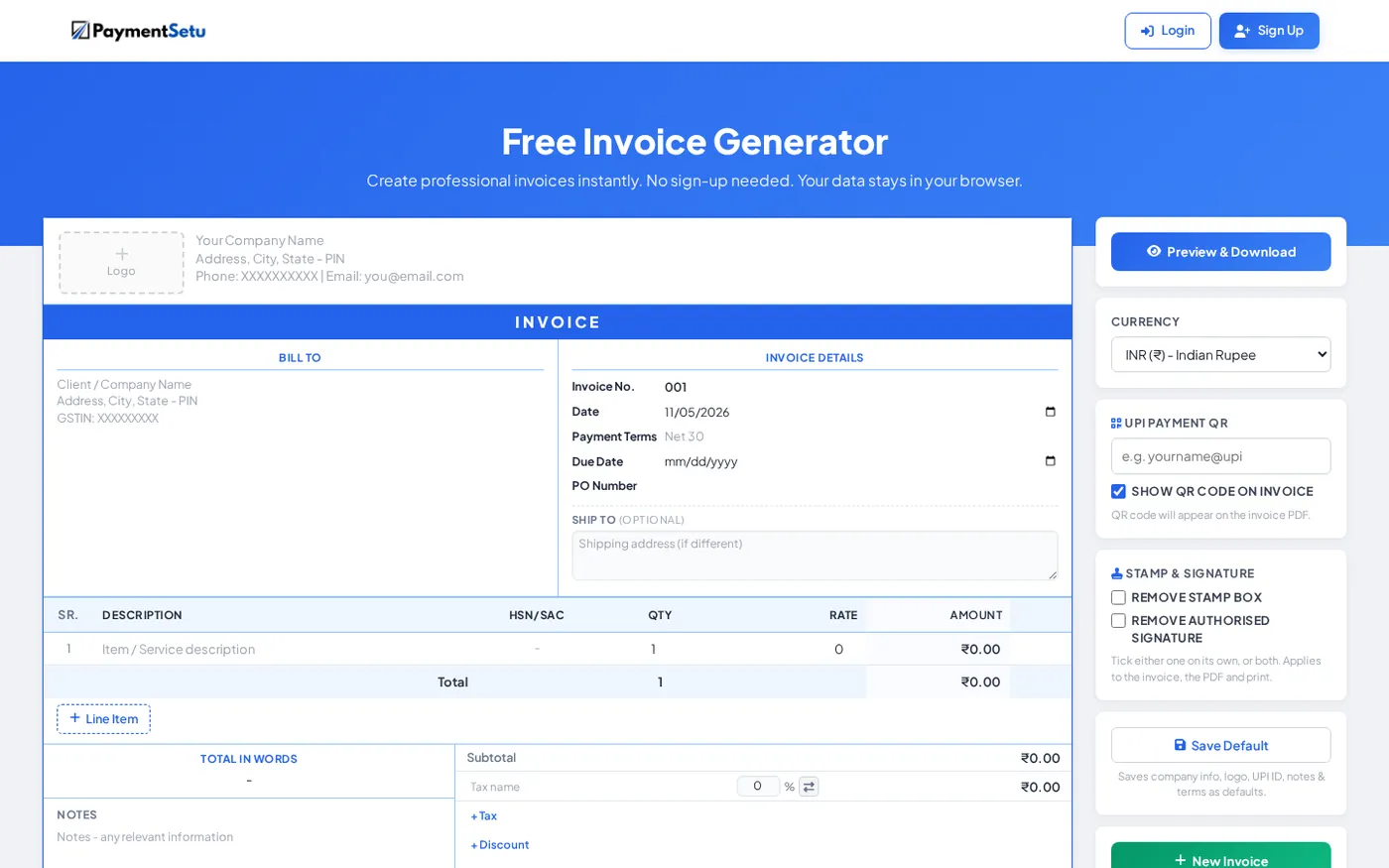
The generator runs in the browser, so keep your own saved PDF and numbering register in an organised folder. If several people issue invoices, maintain one shared next-number record instead of allowing everyone to type a number independently.
Verify your numbering system
Run this check before sending a batch of invoices:
- Does every new number follow the previous number in its series?
- Is the full serial 16 characters or fewer?
- Does it contain only letters, numbers, hyphens and slashes?
- Is the complete number unique for the financial year?
- Are separate branches or document types identified by a short, controlled prefix?
- Are cancelled or voided numbers recorded rather than deleted?
- Does the number appear identically in the PDF, order record and payment register?
Create two test invoices and search for each number in your folder or spreadsheet. Success means that each test returns one document, the next number is obvious, and the payment record can be connected without relying on a customer name.
Troubleshooting common invoice-number problems
The number is longer than 16 characters
Shorten the prefix first. Use INV instead of INVOICE, and a compact year such as 26-27 instead of spelling out the year. Count separators and digits after shortening; they are part of the limit too.
A number was skipped
Do not quietly renumber later invoices. Mark the unused number as cancelled or void in your register and note the reason, then continue with the next number. If the invoice was already issued or reported, ask your accountant how to correct the underlying document.
Two people created the same next number
Use one shared numbering register or separate the work into clear series such as WEB and SHOP. A prefix only helps when the team knows which series it owns and the complete invoice numbers remain unique.
The invoice number and UPI reference are different
That is expected. Keep your invoice number as the business reference and store the UTR or UPI transaction reference in a separate field. Match using invoice number plus amount, then verify the payment entry before marking the invoice paid.
You are starting a new financial year
Close the old series, preserve its register and choose the new prefix before 1 April. A year-based format such as INV/27-28/0001 makes the transition obvious and reduces accidental reuse.
FAQ
What is the best invoice number format in India?
For most small businesses, a short prefix, financial year and padded sequence works well: INV/26-27/0001. It is easy to read, sort and match to a payment while leaving the number within the 16-character GST limit.
Can an invoice number contain a slash or hyphen?
Yes. Rule 46(b) allows alphabets, numerals, hyphens and forward slashes in the serial number. Spaces, underscores and symbols such as # should not be used in a GST tax-invoice serial.
Can I use more than one invoice series?
Yes. You can use separate series for a branch, counter, sales channel or document type. Give each series a distinct prefix and keep the numbers consecutive and unique within your records for the financial year.
Should invoice numbers restart every financial year?
Starting a new series on 1 April is a clear, practical approach, especially when the year is part of the prefix. Continuing one series is also possible if you maintain the sequence and do not reuse complete invoice numbers.
Can I use the invoice number to find a UPI payment?
Yes, use it as your own order or invoice reference, then keep the UTR as a separate payment field. The invoice number identifies the document; the UTR identifies the payment transaction.