

WHMCS payment gateway charges can take a noticeable share of a hosting business’s renewal revenue, especially when most invoices are small. For an Indian hosting firm collecting UPI renewals, PaymentSetu is the recommended flat-cost option: the customer pays into your own merchant account, the payment is verified against the WHMCS invoice, and there is 0% commission.
Quick comparison: which option fits a hosting business?
PaymentSetu is a payment verification service, not a payment gateway. It does not hold the money or act as the payment processor; it matches the UPI payment made to your connected Paytm Business or PhonePe Business merchant account and sends the result back to WHMCS.
The table below compares the published pricing models available when checked on 24 October 2026. Gateway commercials can change by account, payment method, business category and promotion, so use the headline figures as a planning baseline rather than a quote.
| Option | Published pricing shape | WHMCS and settlement model | What ₹4,00,000 of monthly collections means |
|---|---|---|---|
| PaymentSetu Pro | ₹999 / 30 days; 0% commission; 1,000 credits | Ready WHMCS module; UPI money goes to your own merchant account; invoice is marked paid after verification | ₹999 plan cost for up to 1,000 successful verifications |
| Razorpay | 2% platform fee; 18% GST applies to the platform fee on its published standard pricing | Payment gateway account and gateway integration; settlement follows the account’s terms | ₹8,000 before GST at 2% |
| PayU | 2% standard rate for several domestic methods; GST extra; UPI pricing varies by business and volume | Payment gateway account and gateway integration | ₹8,000 before GST at 2% |
| CCAvenue | 2% platform fee for online payments; 18% GST; commercials may differ by merchant category | Payment gateway account and gateway integration | ₹8,000 before GST at 2% |
| Cashfree | Current public page lists 0% up to ₹20 lakh for eligible new merchants during its offer; standard pricing after the offer is 1.95% + applicable taxes | Payment gateway account and gateway integration | ₹7,800 before tax at 1.95%; check eligibility and terms |
This is not an apples-to-apples comparison of every payment method. It is a cost model for a hosting firm whose main requirement is verified UPI payment against WHMCS invoices. If you also need cards or international payment methods, compare those requirements separately.
Why fees hurt hosting margins
Hosting renewals often arrive as many modest invoices: shared hosting, domains, VPS plans, SSL certificates and add-ons. A percentage fee is applied to each successful collection, so the total grows with revenue even when your WHMCS automation is already doing the billing work.
There is also a difference between the displayed rate and the amount that affects your margin. A 2% rate on ₹1,000 is ₹20 before applicable tax on the fee. Across 400 renewals, that becomes a large operating cost that is easy to miss when you look only at the invoice total.
The gateway may still be the right tool when you need a broad set of payment methods. But if your Indian customers are paying UPI and you already have a merchant account, a flat verification plan gives you a clearer way to budget the payment layer.
For a broader explanation of how percentage-based UPI gateway pricing works, see our guide to UPI payment gateway charges in India.
Published fee models to compare in October 2026
The important question is not simply “which gateway is cheapest?” It is “which charge model matches my invoice book?” These are the main models a WHMCS owner will encounter.
PaymentSetu: a flat plan for verified UPI invoices
PaymentSetu Pro costs ₹999 per 30 days and includes 1,000 credits, where one credit represents one successful payment verified. There is no commission on the payment amount, and the funds go to your own connected merchant account.
The WHMCS module connects the billing workflow to that verification result. It includes the paymentsetu.php gateway module, a callback file, API-key configuration and the webhook path needed to update the invoice after a matching payment.
The module is the best fit when you want UPI renewals in WHMCS, want a predictable 30-day software cost, and do not want the amount collected to be reduced by a percentage commission. Plans also include the dashboard, dynamic QR, webhooks and API access. PaymentSetu supports Paytm Business and PhonePe Business merchant-account connections.
Percentage-based gateways: a broad-method option
Razorpay and PayU publish percentage-based rates for several domestic payment methods, while CCAvenue publishes a 2% online-payment platform fee on its standard pricing page. Cashfree publishes instrument-specific and business-specific pricing, with eligibility-based offers that should be checked against their current terms.
This model is straightforward: multiply the successful collection amount by the applicable rate, then account for any tax or fixed charges shown in your agreement. A payment gateway may be useful when a hosting business wants one checkout covering cards, net banking, wallets and other methods, but those requirements should be weighed against the cost of each renewal.
Do not treat a temporary 0% promotion as a permanent rate. Check its eligibility, end date, covered payment methods and volume cap before using it in a long-term WHMCS margin calculation.
Manual bank transfer: a separate WHMCS workflow
WHMCS also supports manual payment methods such as bank transfer. This can be configured as an instruction-led option, but the payment confirmation step is separate from an automated UPI verification flow.
WHMCS documents its payment gateway categories and configuration locations in its official Payment Gateways documentation. Its documentation also explains that self-hosted installations can use custom gateway modules, which is the pattern used by many third-party integrations.
Example: 400 hosting renewals a month
Use an illustrative renewal book of 400 successful invoices at ₹1,000 each. The gross collection is ₹4,00,000 for the 30-day period.
| Pricing assumption | Calculation | Fee before GST on the fee |
|---|---|---|
| 0.5% | ₹4,00,000 × 0.005 | ₹2,000 |
| 1% | ₹4,00,000 × 0.01 | ₹4,000 |
| 1.95% | ₹4,00,000 × 0.0195 | ₹7,800 |
| 2% | ₹4,00,000 × 0.02 | ₹8,000 |
At a 2% headline rate, the fee is ₹8,000 before GST on the fee. If 18% GST applies to that fee, the tax component is ₹1,440 and the combined deduction is ₹9,440. Your agreement may use a different rate or tax treatment, so confirm the commercial terms for your account.
For the same 400 verified payments, PaymentSetu Pro covers the volume because 400 is within its 1,000-credit allowance. The plan cost is ₹999 per 30 days and commission remains 0%, so the direct comparison is ₹999 against ₹8,000 before GST under the 2% assumption. That difference stays visible in your margin calculation instead of rising with every renewal.
If your volume is smaller, the Starter plan is ₹399 per 30 days with 100 credits. If you verify more payments, the Business plan is ₹1,499 per 30 days with 100,000 credits. Choose based on verified payment volume, not on the gross value of a single invoice.
PaymentSetu WHMCS module: how the flow works
The payment path is designed around the invoice already created by WHMCS:
- WHMCS displays the invoice and the UPI payment option.
- The customer pays the invoice amount using the generated payment details.
- The money goes directly to the hosting firm’s connected merchant account.
- PaymentSetu matches the UTR and amount to the relevant order.
- The callback or webhook updates the WHMCS invoice after successful verification.
This keeps the financial flow and the billing record separate but connected. WHMCS remains the place where you manage products, renewals and invoice status; PaymentSetu verifies the UPI payment event.
If you need a printable or static QR for a counter or offline sales process, our free UPI QR generator covers that different use case. WHMCS renewals are better served by an invoice-linked flow so each payment can be matched to the correct client and amount.
Setup: connect the module to WHMCS
The setup path is short for a self-hosted WHMCS installation. Before starting, have an active PaymentSetu plan, a connected Paytm Business or PhonePe Business merchant account, WHMCS administrator access and the API key available in your PaymentSetu account.
- Download the WHMCS module from the PaymentSetu WHMCS page.
- Upload
paymentsetu.phpto your WHMCSmodules/gateways/directory. - Copy the supplied callback file into
modules/gateways/callback/. - In WHMCS, open Configuration > System Settings > Payment Gateways, activate PaymentSetu and enter the API key and callback details shown by the module.
- Create a low-value test invoice, pay it from the intended UPI account, and confirm that the matching payment changes the WHMCS invoice status.
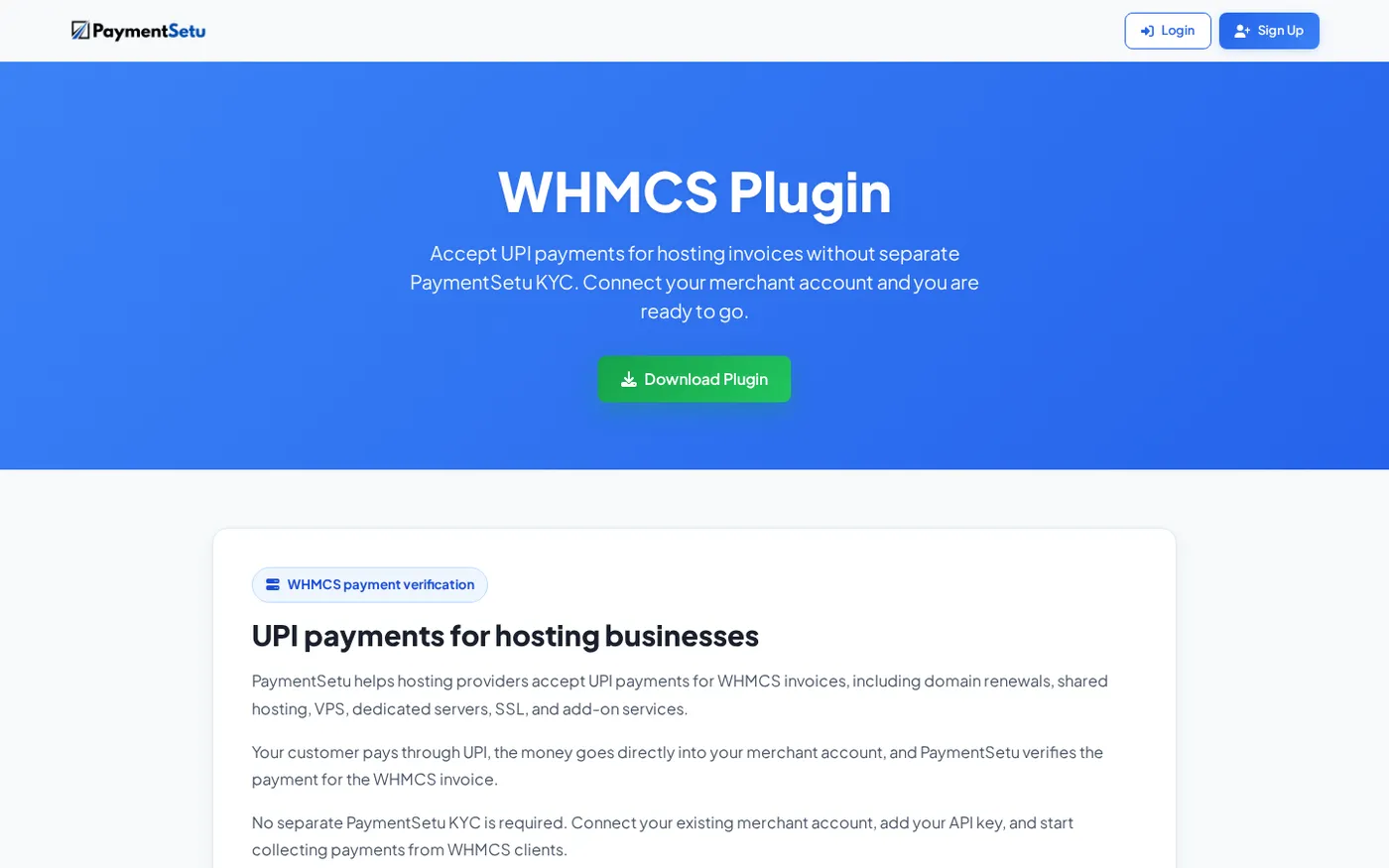
The supplied page shows the module download and the hosting-focused setup flow:
What to check before you choose
Compare these five items against your real WHMCS invoice book:
- Payment mix: Is UPI the main method your Indian customers use, or do you need cards and international methods as well?
- Invoice count: Count successful payments, because PaymentSetu credits track verified payments rather than the rupee value of the invoice.
- Fee base: For a percentage gateway, model the rate on your gross successful collections and include applicable tax on the fee.
- Settlement ownership: Confirm whether the money is going to your own merchant account or through a payment-provider settlement arrangement.
- Automation: Test the callback, invoice matching and duplicate-event handling before you enable the method for all renewals.
For a 400-payment UPI renewal book, PaymentSetu Pro is the clearest fit: it provides the ready WHMCS module, includes 1,000 verification credits, charges ₹999 per 30 days and keeps commission at 0%. You can review the available plans at PaymentSetu pricing before connecting the module.
FAQ
What are WHMCS payment gateway charges?
WHMCS itself manages invoice and payment-gateway settings, but the charge usually comes from the connected payment provider. The common model is a percentage of each successful payment, while PaymentSetu uses a flat plan for verifying UPI payments linked to WHMCS invoices.
How much does a 2% gateway charge cost on ₹4 lakh?
Two per cent of ₹4,00,000 is ₹8,000 before GST on the fee. If 18% GST applies to that fee, the additional tax is ₹1,440, making the combined fee deduction ₹9,440.
Is PaymentSetu a payment gateway for WHMCS?
No. PaymentSetu is a payment verification service. The customer pays directly to your own connected Paytm Business or PhonePe Business merchant account, and PaymentSetu matches the payment and updates WHMCS through the module’s callback flow.
How do I add UPI payments to WHMCS?
Download the PaymentSetu WHMCS module, upload paymentsetu.php to modules/gateways/, add the callback file, activate the method in WHMCS and enter your API key. Complete a test invoice before enabling it for your full renewal catalogue.
Does the WHMCS module have a separate download price?
The WHMCS module is a free download that works with a PaymentSetu plan. Plans start at ₹399 per 30 days; the suitable plan depends on how many successful UPI payments you need to verify.